
Israel’s Attrition War Showdown with Russian MiGs
Updated: Jul 12

The French made Mach 2 capable Mirage IIIc entered service with the Israeli Air Force in April of 1962. During a four year gestation period, IAF engineers worked with Marcel Dassault to improve the fighter’s gun sight, engine reliability, and lethality of the Mirage’s twin 30mm Defa guns. The Mirage’s first kill came during France’s Bestial celebration on July 14, 1966 when Yoram Agmon of the 101 squadron, flying Mirage no. 59, downed a Syrian MiG-21F-13 for the first MiG-21 kill in the world. By the end of the June 5 -11, 1967 “Six Day War”, Israeli flown Mirage IIICs accounted for downing 70 jets in air to air combat, proving the Mirage as the world’s premier dog fighter.

Within days after the Six Day War ceasefire declaration, a new war began, the 1,000 day “War of Attrition”. Daily artillery bombardment of Israeli out posts along the cease fire lines with Egypt, Syria and Jordan could be answered only by airplanes of the IAF. To brake the stalemate along the cease fire lines, the IAF initiated the “Boxer” campaign, striking military targets deep within Egypt using the F-4E Phantom. Unable to counter IAF strikes deep within Egypt, president Gamal Abel Nasser turned to the Soviet Union in request for direct intervention in the fighting. By the end of 1969 there were over 1,700 Soviet advisors in Egypt, including pilots of the Russian 35th and 135 air regiments equipped with new MiG-21MF Fishbed J. The new third generation MiG-21 was capable of Mach 1 dash speed at sea level, had a new twin barrel 23mm canon and could carry four infra red homing air to air missiles.


Wishing to avoid a direct confrontation with the world's second largest super power, the Israeli government curtailed IAF F-4E deep strike missions into Egypt and limited its operations to within 30 kilometers of the Suez Canal cease fire lines. The Israeli government lack of resolve was challenged time and again by the Russian pilots who harassed Israeli jets along the Suez, to a point where on July 25th , 1970 a 135th regiment MiG-21MF hit a 102sq A-4H Skyhawk with an AA-2 Atoll missile.

The direct attack on an IAF jet fighter by the Russians could no longer be ignored. At 12:00 noon August 30, 1970 sixteen of the IAF’s best fighter pilots, sharing 59 air to air kills between them, were assembled for mission "Rimon 20". A pair of 69squadron F-4E Phantoms and two pairs of 119 squadron Mirage IIICs took on MiG-21MF’s of the 35th and 135th air regiments.

As the number of Russian MiGs in the air reached 21, 117sq and 101sq Mirages laying in waiting joined the fight. Within two and a half minutes of air to air combat, five Russian MiGs were downed.

Mirage 778 was flown by Captain Avraham Salmon who downed the first MiG-21 of the fight and shared a second MiG-21 kill with 101 squadron commander Iftach Spector flying Mirage IIIC no.52.
Captain Salmon’s described the air to air fight with the Russians:
As the first MiG formation climbing up from the west reached 26,000 feet, the 119sq tight recon pair formation split into a finger four and tuned tail from the incoming MiG’s. Salmon was the lead of the second pair of the bogus recon formation, “The MiGs came from the west, to pull them into the fight we turned our backs away from them due east. As they closed within 10-15 miles, we jettisoned our external fuel tanks and continued the turn a full 270 degrees to face them. Gilad my wing man spotted a MiG and quickly broke formation to chase him. I spotted what initially looked like a MiG-21 coming in from below and did a ‘spoon’ maneuver to get under him. As I got closer to my MiG the silhouette became more familiar - it was Aviu’s Phantom. Behind Aviu were a pair of MiG-21MFs in hot pursuit that were approximately 1,200 meters ahead and to the left of me. I warned Aviu that there were MiGs on his tail and broke left to get behind the MiG formation leader. He was too far for a guns shot so I launched an [AIM-9D] Sidewinder. The Sidewinder quickly found its mark, as it impacted the MiG it shook, lifted its nose into a stall and exploded. “ A chute opened, it was Captain Nikolai Yurchenko the commander of the 135th regiment at Bani Suef. He did not survive the ejection as fierce winds slammed him on to the rocky terrain below.

With one MiG downed Salmon went after the MiG formation leader who’s wingman he downed seconds earlier. In this MiG-21MF sat Zarovlev, who was heading back to his base in the Egyptian Delta. As Salmon closed in on the MiG, its pilot noticed him and started going wild, braking hard often and fast. "I shot at him my second and last AIM-9D which exploded close to him but did not bring him down. The MiG broke violently and all of the sudden I saw a missile pass 2 meters above my canopy heading straight for the MiG. As quickly as the first Sidewinder rushed by, a second followed, as Spector in Mirage no.52 broke hard in search for other MiGs. I followed the MiG and saw how he came out of the explosions intact. With me on his tail, he made a couple of cork screw turns which did nothing but give me time to close in to gun range of 600-800 meters. I expanded all of my shells at the MiG which did not go down and turned to head back on cruise power in order to reach Refidim.” The fifth MiG-21 piloted by Captain Vladimir Zarovlev did not make it back to base, seconds after Salmon turned away, the MiG-21MF trailing smoke continued in a high speed shallow dive into the ground below. Zarovlev managed to eject but his chute did not deploy in time and he was killed.
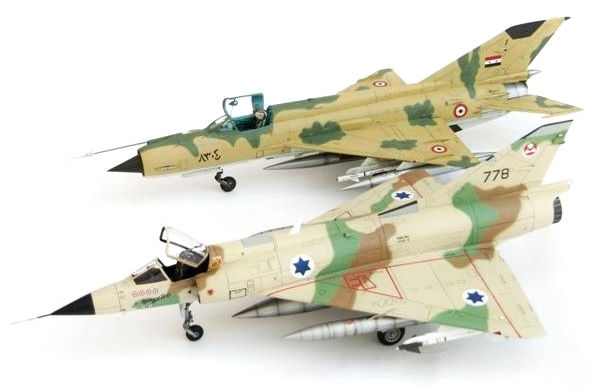
On the eve of July 30, 1970 pilots of the IAF were not the only ones to celebrate, their Egyptian counterparts did likewise. Showdown over “Texas” led to a cease fire which ended the War of Attrition and to newly appointed president Anwar Sadat to send the Russians back home, returning the defense of Egyptian skies to the pilots of the Egyptian Air Force.
Building the model:

Eduard’s limited edition release of the Mirage IIICJ’s contains a detailed resin Atar 9C exhaust nozzle fitted to Mirage 778 flown by Abraham Salmon in the July 30, 1970 “Texas” shoot-out with the Russians.


The greatest improvement made in the Profipack Mirage is the color photo etched cockpit and improved tooling fuselage halves. The kit’s ejection seat is enhanced with photo etched seat belts, but I preferred Pavla’s MB Mk.4 resin ejection seat S48014, which has seat belt detail molded on.

Fuselage:
I began assembly by first removing the aft end of the fuselage at the kit’s existing panel line. Repeated scribing, guided by thick labeling tape was followed with razor saw had the aft end removed in short time. Intake blanking diverters parts E4 and E9 were not attached to each other, but to the fuselage sides instead. This enabled fuselage flexure when mating it with the wing roots. The cockpit tub and aft bulkhead were installed along with the nose wheel well.

Omitted from the instructions is the need to add ballast in the nose. 20 grams of fishing weight were added atop the nose gear wheel well prior to closing the fuselage halves. Into the radome I added a pitot tube made of hypodermic needle and metal rod which was set in place with ample amounts of super glue injected into the hollow radome.

With the fuselage together, PJ’s short tail fairing was attached. The resin section is slightly smaller than the kit’s aft end which required sanding to have the joint smooth. Unfortunately the extensive sanding resulted in the obliterating the small vents atop the aft fuselage. These were carefully replaced by scribing. The exhaust nozzle needs to be fitted into the resin shroud prior to attaching the wings. The exhaust was painted Xtracolor X508 Burnt Iron, with the interior lining Humbrol 78 Interior Green. The nozzle’s external petals were dry brushed Humbrol 11 silver and both internal and external recessed detail given a wash of flat black.

Salmon’s Mirage also had missile warning electrics fitted to above the rudder which was added using sheet plastic.

The upper fuselage blade antenna provide in the kit was incorrect in shape and a new one was made of sheet plastic, using photos for size reference. To facilitate the antenna’s installation after painting, a recess was made in the plastic.

Wings:
The upper and lower wing halves were cemented at the leading edge and tip, with the trailing edge left free to flex. Once the wing and fuselage assemblies were mated to each other, super glue was used to cement these subassemblies together from inside the wheel wells.
The separate wing trailing edge control surfaces were tricky to install, requiring removal of part D8 and D9 locating tabs. Left and right wing actuator fairings D17 need to be installed prior to the installation of mid flaps D13 & D16 since gaps between these parts need to be filled with plastic strip shims. The angle of the outboard elevons D18 and D21 is determined relative to the mid flaps.
The fit of clear wingtip position lights D14 and D15, as well as lower forward fuselage position light D17 is poor. Install them prior to painting, since they require filing and polishing to be flush with the surrounding structure. The upper wing tip position light clear parts I8 were left off and plastic rod was used to reduce the diameter of the opening for installation of a clear lens after painting.
External stores:

Most of the kit’s external stores are not relevant to an IAF Mirage. The wing mounted super sonic fuel tanks required scratch built aft fins to represent an Israeli version. The kit’s simplistic wing tip missile rails were removed, and a pair of Sidewinder rails were taken from a Hasegawa A-4 kit.
I attached the wingtip pylons at this early stage due to the need for plastic shims to fill the gaps between the elevons and actuator fairings. AIM-9D missile are actually R-13 look alike left over from my Eduard MiG-21MF.

Sidewinder markings came from Two Bobs decal sheet 48-086 air to air missile markings.

A fuel tank I found closest in resembling the Mirage’s centerline super sonic fuel tank was found in Monogram’s 1/48 A-10. It’s aft fins were replaced with scratch built aft fin which was mounted on a scratch built center line pylon made of sheet plastic.

Cockpit:
Cockpit assembly was attended to just prior to the painting stage. I did not follow Eduard’s instructions which show the attachment of the pre-painted photo etched instrument panel, prior to attaching the gun sight. As a result, I had to trim and bend the photo etched parts around the gun sight in order to have the instrument panel fit. This resulted in a poor representation of the instrument panel layout, which luckily for me is predominantly black so my mistake is not too visible. Dry fit of the windshield revealed that its forward edge is higher than the ramp ahead of it. The windshield was attached to the fuselage with Tamiya orange top viscous plastic weld cement, and after a day’s drying time the windshield was filed, sanded polished and coated with Future.

Painting, Weathering and Decaling:
The intakes, wheel wells, landing gear door interiors, gears, wheel hubs and actuators were sprayed Humbrol 56 aluminum. With the wheel wells dry and clear parts masked, the windshield, canopy and radome were sprayed Humbrol 33 flat black. The entire model was painted Testors Model Master f.s.35622 Duck Egg Blue, which is the color used on the Mirage’s undersurface. Application of the blue on the upper surface served as a primer to reveal flaws and act as a canvass for drawing the camouflage demarcation lines with a pencil. For the sand I used Xtracolor X105, the green is Humbrol 120 and brown Humbrol 119. To reduce the amount of overspray, to the flat colors I added a few drops of Testors enamel based clear coat, and used Lacquer thinner to dilute the paint. The flush antenna fairings on the vertical fin tip, vertical fin base and upper fuselage spine were painted flat black, masked and sprayed Humbrol 127 Light Ghost Gray.
The external fuel tanks were primed with Tamiya gloss black, thinned with lacquer thinner which was followed with a layer of Alclad Dark Aluminum. Thin strips of Tamiya tape were used to make the welding rings typical to the fuel tanks over which Alclad Aluminum was sprayed. Between the rings and on the lower surface of the fuselage, panel lines were enhanced with highly diluted spray application of Tamiya X-19 Smoke.
The kit’s recessed panel line and rivet detail was accented with a wash of oil paint diluted with turpentine. Once dry, the excess oil paint was removed with a paper towel brushed in the direction of the air flow. The oil paint was sealed in place with a spray on coat of Pledge - Future Klear diluted with alcohol.
Although the kit’s decal sheet is printed by Cartograph, I opted for more accurate squadron markings, kill roundels and numerals found in IsraDecal IAF Mirage sheet IAF-33.
The decals were sealed in place, sandwiched between brush on layers of Pledge - Future Klear, that helped them conform to the recessed detail. Some minor stencilling not found in the IsraDecal sheet were taken from the kit’s decals.

Finishing:
Once all decals were applied and the model still finished in gloss, final assembly began with attachment of the landing gears and doors. Pitot tubes and spine antenna were attached and painted and the model sprayed a layer of semi gloss clear mixed from Tamiya Flat, Future Clear and alchol. Last to be applied were clear red and clear blue wing tip lights, missiles, fuel tanks, and canopy.

Paints Used:
Xtracolor: X105, X508
Humbrol: 11, 28, 33, 48, 53, 56, 72, 78, 116, 119, 120, 127, 153, 154, 225.
Testors Model Masters: f.s.35662
Tamiya: X-1, X-2, X-19, X-23, X-27.
Alclad II: Aluminum, Dark Aluminum
Weathering Agents:
Oil Paints: Gray and Black

Further Reading:
Phantoms Over Cairo by Danny Shalom – Ba' Avir Aviation and Space Publications.
G-Suit by Merav Halperin and Aharon Lapidot - IDF Ministry of Defense Publications
Osprey a/c of the aces no.59 – Israeli Mirage and Nesher Aces by Shlomo Aloni (2004).
Biaf Israel's Air and Space Magazine: issue 16, issues 75-76 (Fall 1993), issue 93 (Winter 2003-04).
Aviation Week and Space Technology Magazine: October 6; 1968, January 13, 1969; January 27, 1969.
Bitaon Chail Ha'Avir (IAF) Magazine: issue 197 (April 1994), issue 254 (October 2003), issue 256 (February 2004).
IPMS/IL Kne Mida Magazine issues 31 & 32.
119sq 50th anniversary album by Amir Amitai – IDF Ministry of Defense Publications
Acknowledgments:
Raanan Weiss – IsraDecal Publications for Mirage decals and photos.
Gil Hezkia - for Egyptian Air Force corrections and photographs.
PJ productions for the 1/48 scale Atar 9C engine conversion.
Eduard models– for the Mirage IIIC Profipack review sample.


If you like this article and want to support my efforts in maintaining this web site you may make a donation through my PayPal account yoave@elal.co.il
Thank you,
Yoav Efrati


Nicely written article. Fantastic modeling too!