
Special Hobby Meteor Nf.13
Updated: Oct 12, 2025
Building Special Hobby’s Gloster Meteors NF Mk.11 kit as an Israeli Air Force NF Mk.13 – by Yoav Efrati

In 1953, the Israeli Air Force conceived the development of a new squadron aimed to counter Royal Egyptian Air Force operation of the night navigation capable Sterling bombers. Initial trials at night intercept using NF Mk.30 version of the de Havilland Mosquito were disappointing and in 1955, the Israeli government requested Britain's approval for the sale of the advanced radar equipped NF Mk.14 version of the Meteor to Israel.

On July 26th, 1956 Egyptian leader Gamal abed el Nasser nationalized the Suez Canal and expelled the Anglo-French personnel operating it from Egypt, along with all British army forced stationed on Egyptian soil. After British government approval of the sale of radar equipped Meteors to Israel, the new 119 "Bat" squadron was formed on August 9th, 1956 based at Ramat David, alongside the 117 Meteor squadron. The Bat squadron did not receive the NF Mk.14 initially desired but the less advanced surplus radar equipped NF Mk.11 Meteors modified to operate in the hot climate of the Middle East designated NF. Mk.13.

On September 8th, 1956 the first three NF Mk.13 Meteors arrived in Israel and were given tail numbers 50, 51 and 52.
To regain control of the Suez Canal, Britain France and Israel planed operation "Machbesh" (Steamroller in Hebrew) which was to commence at 17:00 of October 29, 1956. On the night prior to the operation, the 119sq was to conduct a secret mission, shoot down the Egyptian Air Force IL-14 transport carrying the Egyptian army high command on their return flight from Syrian. Prior to this mission, 119sq commanding officer Captain Yoash Tsiddon and navigator Lieutenant Elyashiv Broshflew practice intercepts in Meteor NF Mk.13 no.52 in order to calibrate the Meteor's Al-10 radar against slow flying T-6 trainers.

On a moonless night of 28-29 October 1956, IAF intelligence confirmed the Egyptian IL-14 transport take off, and scrambled the crew for the intercept. Fitted with three external fuel tanks, contact was made with the target at 10,500 feet, far from the Mediterranean Ocean. Upon reaching the target, it was realized that fuel was not transferring from the external wing tanks, limiting the duration and distance for the intercept. Tzidon closed in on the transport and was able to distinguish men in uniform inside the cabin. It took 10 minutes to confirm that this transport was the intended target and receive IAF commander Dan Tolkovskie'sapproval to open fire. At a near stall speed of 155 knots Tzidon opened fire, to be temporarily blinded by the flash of the tracer rounds. As canon fire commence, the Meteor entered a spin due to the right canon being jammed. Missing the target, Tzidon closed in to 50 meters from the target, veered the Meteor's nose aside and again opened fire. This time the asymmetrical yaw sprayed the Ilyushin with gunfire causing it to ignite into flames. Meteor 52 again entered a spin, from which Tzidon recovered only 500 – 1,000 feet above sea, the "Suez War" began with the Meteor's faithful intercept.

On February 16, 1958 the 119 Bat squadron transferred operations from Ramat David to Tel Nof. Two months later, Meteor NF Mk.13 tail numbers 55 and 57 successfully landed in Israel. On April 3rd, 1958 the first four of seven Vautour IIN nigh interceptors landed in Israel to serve alongside the Meteors which by then served as two engine conversion trainers for the pilots flying the more advanced Vautour. In July of 1963, the 119 squadron ceased Meteor and Vautour operations in preparation for the Mach 2 capable Mirage IIIB/C.

Meteor NF Mk.13 tail number 57 (manufacture s/n 5582) was transferred to the Israel Aircraft Industries test flight center. Initial use of Meteor 57 was to test the altimeter developed for IAI's "Gabriel" surface to surface missile. On 20 July 1978, Meteor NF.13 tail number 157 conducted the last flight for the Meteor over Israeli skies when flown to reside at its permanent home in the Israel Air Force Museum at Hatzirim Air Base outside of Beer Sheva.


Building the Meteor NF.13:
Special Hobby's new tooled, long winged night fighter, Meteor versions NF Mk.11/12/13/14 have nothing in common with the previous Special Hobby "short winged" versions. These new kits provide a far superior cockpit, engine and wheel well detail. Special Hobby's long winged NF.11 Meteor kits released so far, retain all the optional parts needed for a hot climate NF.13 versions used by the Israeli Air Force.

I opted to build a mid-life high visibility original camouflaged NF.13 number 50 of the 119 squadron, alongside the unique desert camouflaged NF.13 no.157 Israel Aircraft Industries test airframe, which flew the last flight for the Meteor over Israeli skies on 20 July 1978.

Special Hobby Meteor Kit Assembly:
To choose the parts applicable to the NF Mk.13, I received the gracious assistance of Special Hobby's own Meteor kit designer.

The parts shown in the kit instruction assembly steps are followed by the NF Mk.13 alternatives used: Cockpit assembly applicable to the NF Mk.13: step 1, D35/instead of D37; step 3, E10/instead of E9 with upper console removed; step 5, D43/instead of D40; step 16, E6/use same E6.

To the seats I added seat belts fabricated from 1mm wide strips of Tamiya Tape, affixed in place with cyanoacrylate cement and the right side plastic handles were replaced with metal staple. To provide depth to the all-black cockpit, I brush painted it with Humbrol 67 Panzer Grey, dry brushed the raised detail with white and followed up with a wash of acrylic based Tamiya X19 Smoke. I added color by painting the wall mounted extinguisher bottles red and used a wooden tooth pick to paint the instrument panel knobs and radar console using gloss white, red and green.

The fuselage halves were joined together using Tamiya Extra Thin cement to form a "welded" bead along the length of the fuselage. Do not use this cement to joint the fin, the fin halve trailing edges are thin and will melt, use a milder cement such as Revell contact cement or tube glue.

Meteor 157 tail tip was trimmed off and the kit provided camera mount part A6 was glued in place. Meteor 50 also had a tail mounted sensor which was smaller and this was simulated with square plastic rod.

Unlike earlier versions of the Meteor kits produced by Special Hobby, the night fighters enjoy detailed engine faces, intake ducts as well as exhaust nozzles and turbines. The intakes and engine faces were painted Revell 90 silver, detailed in black and given a wash of acrylic based Tamiya X19 smoke.

The exhaust ducts and turbines were painted gunmetal and dry brushed dark brown. Placement of the exhaust duct step 23 assemblies shall be positioned to allow the duct to extend past the wing/nacelle recess by approximately 1mm, enabling exhaust nozzles parts D7 to fit over this extension.

Intake duct assemblies step 18A and 18B should be positioned 1mm aft of the wing/nacelle forward edge, to enable the intake rings B2 and B5 inner extension to fit inside the nacelle.

When assembling step 25, do not remove both intake wing segments B1 and B4 from the parts tree, positioning them inside the ducts requires dry fitting and trimming.


Moving on to step 26, one must remove 1mm from each side of the center wing opening in order to obtain a 15mm gap required for the fuselage.

Steps 27 and 28 are dedicated to wheel well installation followed by step 29 where the upper and lower wing halves are joined together. If the location of the intake and exhaust ducts are incorrect, gaps will be seen in the wheel wells and engine nacelles. In hind sight, I suggest cutting off the wing the guns to enable easier filing and sanding of the nacelle and wing joint area.
I recommend that step 30 intakes (B2 and B5) as well as the exhaust nozzles (2 X D7) be dry fitted to their required location prior to cementing the upper and lower wings together in step 29. The NF horizontal stabilizers are thin and sharp so to avoid melting the tongue inserts I cemented them into place using cyanoacrylate cement. The NF's landing gear is exquisitely detailed, robust, easy to assembly and does not require metal pin reinforcement.

Landing gear and door installation steps 33 through 42 parts were painted and left off the model till after it was painted. Step 41 clear nose gear door clear plastic landing lights were replaced with reflective lenses cemented in place using 5-minute clear epoxy. When joining the upper and lower halves of the external fuel tanks in step 43, use glue sparingly and do not sand off the peripheral riser located at the center of the fuel tank. Step 46 gun barrel parts D24 and left wing tip pitot tubeD26 were used for dimensional reference and replaced with metal rod and tubing.
Dry fit of the centerline fuel tank A3, revealed a wide gap at its aft end; this was filled with sheet plastic and cyanoacrylate cement. Next came the NF Mk.13 air conditioning intake parts 8 and 10 which were assembled and attached just ahead of the fuel tank as shown in an accompanying photo.
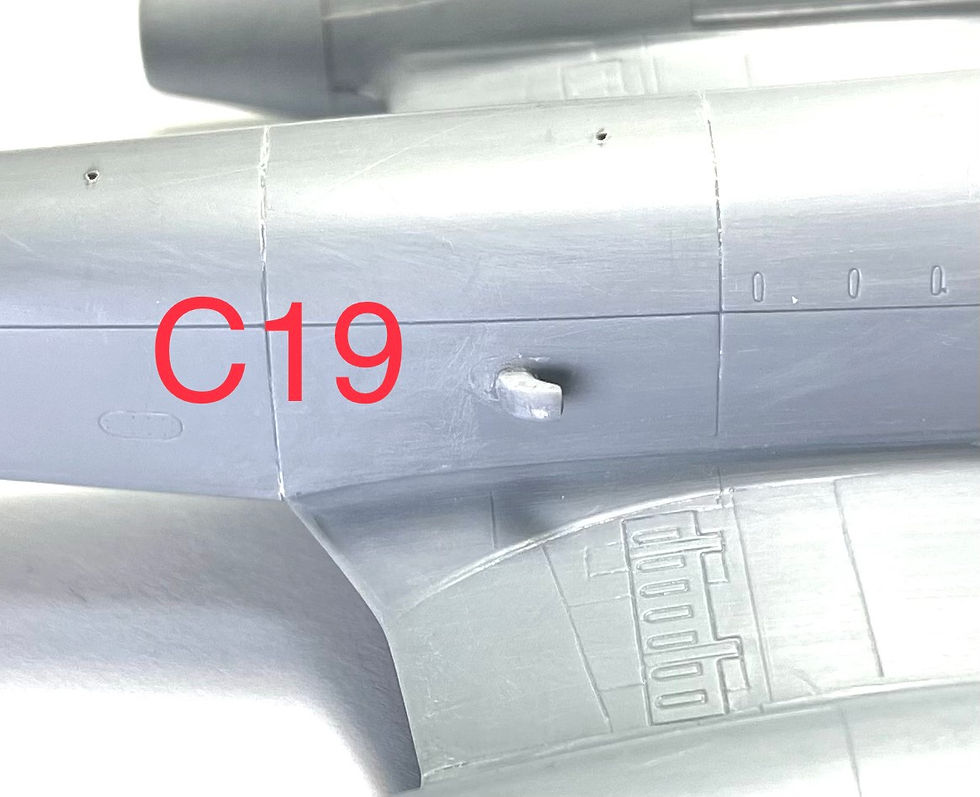
Another unique feature to the Mk.13 is the mid fuselage air scoop, part C19; to strengthen it's attachment to the fuselage, holes were drilled and brass rod inserted through both. To help in locating the holes required for the upper and lower aft fuselage and upper wing antennas, panel lines and antenna locations were marked on a strip of masking tape after which the tape was applied to the curved fuselage and wings and locations indented into the plastic using a metal pin.
Dry fit of the canopy showed that part E13 needs trimming. Attachment of the canopy to the fuselage was made using two types of cement; where the canopy contacted the fuselage, Revell Contacta cement was used, were gaps were present, along the windshield and aft end of the canopy, clear two part epoxy was used. At this stage, both models could be painted.

The canopies were masked using Special Hobby's M72031 precut mask set which greatly eases this task due to the NF Mk.13's rounded edge windows.

The canopy area and nose radome of both kits were painted using lacquer based Gunze 1500 black surface primer. Using photographs as reference, the models were camouflaged using a Paasche H1 single action airbrushusing the enamel based colors and paints listed in the table below. Meteor 50's lower wings and empennage 3mm wide black and white identification bands were painted prior to applying the camouflage colors. Once painted, the models were sprayed with a layer of Pledge Future Klear diluted with pharmaceutical alcohol for quick drying.
The prepainted landing gear and doors and external fuel tanks were attached at this time using either cyanoacrylate glue or Devcon clear two part epoxy. Next came decal application with the kit stencils applied per kit instructions to Meteor 50 while Meteor 157 had virtually no stencils applied. IsraDecal sheets IAF-5, IAF-25 and IAF-93 were sourced for the unique Israeli Air Force markings. All decals were layered onto the model's surface using Future Klear with eliminates silvering and covers them with a tough acrylic coat ready for the oil paint wash that followed. Van Gucht oil burnt sienna and black were mixed, diluted with turpentine and applied to the model's recessed panel lines. Excess oil paint was removed with cotton swabs and the dried with a hair dryer set on low heat. A final coat of a semigloss clear mixed using Future Klear, Tamiya X21 Flat Base and alcohol gave the models a uniform satin finish.
The last items to be attached were the antennas, Meteor 50's wing tip and lower aft fuselage antennas were furnished from staples which have the advantage of being flat sided. The upper fuselage whip antennas common to both Meteors were furnished from Albian Alloys 0.02 mm wire. The kit provides clear wing tip lights but I founded easier to paint the edges right-blue, left-red and apply Devcon clear epoxy for the clear lenses.


Meteor number 50 finishing notes:
Lower wings and empennage high visibility 3mm wide white-black-white stripes were painted on the model. Fuselage, upper left and lower right wing 12.5mm diameter roundels were obtained from IsraDecal sheet IAF-5. Early type 119sq insignia was found in IsraDecal sheet IAF-93.

Meteor number 157 finishing notes:
Meteor NF.13 IAI retirement desert scheme is nearly devoid of markings. Lower wings and horizontal stabilizer tips day glow stripes were taken from IsraDecal Meteor sheet IAF-25

Acknowlagements:
I want to thank Ra'anan Weiss of IsraDecal Publications for providing me photographs that made this NF Mk.13 Meteor project possible and the staff at Special Hobby for their generous time and efforts that made this NF Mk.13 kit build.
If you like this article and want to support my efforts in maintaining this web site you may make a donation through my PayPal account yoave@elal.co.il
Thank you,
Yoav Efrati


Thanks for share this steps Yoav, specially the fin tip and steps 25 and 26, another helpfull tip the masking tape measurement for antennas!! 👍😀